

The Brothers That Just Do Gutters · Charleston
Charleston Storm Check: Hurricane, Flood and Wind History by County
Pick your town and see every tropical storm, coastal flood, flash flood, thunderstorm wind, hail and tornado record NOAA logged in your county from 2016 to 2025, the latest storm, and what to check on your gutters afterward.
- NOAA Storm Records, 2016 to 2025
- Town by Town Lookup
- Free Post-Storm Gutter Check
The Brothers That Just Do Gutters
Charleston
- Loose hangers, split seams and crushed downspouts found
- Every downspout flushed and tested after the storm
- Repair when repair is right, replace when it is not
- Free, no-pressure written estimates
Quick answer
How often do hurricanes, floods and wind storms hit Charleston? From 2016 through 2025, NOAA logged 526 thunderstorm wind reports on 124 different days across Charleston, Berkeley and Dorchester counties, plus 153 flood and heavy rain reports, 161 hail reports and 30 tornado reports. Sixteen tropical systems left 44 tropical storm and hurricane records, and coastal flooding was logged on 39 separate days. Use the lookup below to see your own county, then let The Brothers That Just Do Gutters Charleston check your gutters and downspouts for free after the next storm. Call (843) 867-2267 or book online.
Source: NOAA NCEI Storm Events Database, detail files 2016 to 2025, Charleston, Berkeley and Dorchester counties and their NOAA forecast zones, counted by The Brothers That Just Do Gutters Charleston. Tropical and coastal flood records are filed by forecast zone.
Storm Check lookup
Pick your town or county and see its storm record
Ten years of NOAA storm records for Charleston, Berkeley and Dorchester counties, counted one by one: tropical storms, coastal and flash flooding, thunderstorm wind, hail and tornadoes, plus the biggest hail, the latest storm and the months to watch.
Turn on JavaScript to use the lookup. Across Charleston, Berkeley and Dorchester counties from 2016 to 2025, NOAA logged 526 thunderstorm wind reports, 153 flood and heavy rain reports, 161 hail reports, 30 tornado reports, 44 tropical storm and hurricane records, and coastal flooding on 39 days.
What Lowcountry storms do to gutters
After a storm on your street, this is what our crews look for, and what you can spot from the ground:
- Water sheeting over the front. Tropical rain can arrive faster than a packed or undersized run can move it. Splash marks on the siding or a washed-out bed below show where.
- Wind-driven rain behind the gutter. Sideways rain finds the gap between the gutter and the fascia board. Look for streaks on the siding or a wet soffit after the storm.
- Live oak limbs on the roofline. A falling limb can flatten a run or pull hangers out of the fascia, even when the gutter still looks straight from the driveway.
- Flying debris in the trough. Twigs, leaves and Spanish moss torn loose by the wind settle in the trough and dam it.
- Pine straw packed in the outlets. Pine straw mats over the downspout openings, so the next rain backs up instead of draining.
- Downspouts dumping under the house. On a raised home, a downspout knocked off its extension sends the roof’s water under the house, around the piers and the stairs.
- Salt on hangers and screws. Near the water, salt air rusts steel hangers and fasteners. Storm wind finds the weak ones first.
- Seams and end caps pulled open. Hours of wind flex long runs. Drips at the corners in the next rain usually mean a seam worked loose.
Tropical storm or summer squall just came through? A local crew will walk the roofline, flush every downspout and show you what we found before anyone talks price.
How this works and sources
We downloaded NOAA’s Storm Events detail files for 2016 through 2025, kept the South Carolina records for Charleston, Berkeley and Dorchester counties and counted them ourselves. Thunderstorm wind, hail, tornado, flash flood, flood and heavy rain are filed by county, and each one is a single NOAA report; a tornado that crosses a county line gets one in each county. Tropical storm, hurricane, tropical depression, storm surge and coastal flood records are filed by NOAA forecast zone (Berkeley has two, inland and tidal), so we count one record per storm, per county, per day and per type, and call them records, not storms. Days are separate calendar dates, so a storm that runs past midnight counts on two. The most recent report also checks NOAA’s 2026 file, which runs through June 2026.
Places follow the NOAA record as NOAA lists them, so you may see a crossroads, island or airport name instead of your town. When two reports tie for the biggest hail, strongest wind or strongest tornado, we show the most recent. Quoted report text is NOAA’s. Dollar figures are NOAA damage estimates, and many records carry no dollar figure at all, so treat them as a floor, not a total.
Source: NOAA NCEI Storm Events Database, detail files 2016 to 2026.
The storms behind the numbers
Six storm days Lowcountry roofs still remember
Most storm days here bring a few trees down and a street or two under water. A handful each decade bring a hurricane’s surge, a record tide or a squall line that drops limbs across all three counties. These are the ones from the last ten years.
We pulled every tropical, coastal flood, flood, thunderstorm wind, hail and tornado record NOAA keeps for our three counties and sorted them by day. Thunderstorm wind is the steady one: 526 reports on 124 days, led by Charleston County with 201 and Dorchester with 192. Hail is less common but real, with 161 reports on 55 days, and 83 of them were 1 inch or bigger.
Water is the other pattern. NOAA logged 153 flash flood, flood and heavy rain reports, 103 of them in Charleston County, and coastal flooding on 39 separate days. Here a gutter has to move rain off the roof while the ground is soaked and the tide may be up, which is why we push for a cleaning before hurricane season, not only after the pine straw drops.
Tropical systems sit on top of all this. Sixteen of them left records in our counties from 2016 to 2025, from Hermine and Matthew in 2016 to Debby and Helene in 2024. NOAA files those records by forecast zone, so one storm can leave a wind record and a storm surge record in the same county. That is why the lookup counts records, not storms: 44 records, 20 days, 16 systems.
The storm days, one by one
| Date | What NOAA logged | Where it hit hardest |
|---|---|---|
| October 8, 2016 | Hurricane Matthew pushed Charleston Harbor to 9.29 feet, then its third highest storm tide, and wrecked over 30 dune walkovers on Isle of Palms | The Charleston County coast and peninsula, with tropical records in Berkeley and Dorchester |
| April 19, 2019 | 37 thunderstorm wind reports in one afternoon, the most of any day in ten years, including an 81 mph gust on a Charleston rooftop anemometer | Charleston (16 reports), Dorchester (12) and Berkeley (9) |
| April 13, 2020 | An EF3 tornado, winds estimated at 145 mph, on a 5.74 mile path just east of Moncks Corner | Berkeley and Dorchester, with EF1 tornadoes on Seabrook and Kiawah islands |
| December 17, 2023 | A coastal storm pushed Charleston Harbor to about 9.86 feet, the fourth highest tide on record there and the highest not tied to a tropical system | Charleston County, plus Daniel Island in Berkeley |
| June 10, 2024 | Hail up to 2 inches north of Ladson, damaging house siding, and wind estimated near 85 mph | Dorchester, Berkeley and Charleston |
| Sept. 26 to 27, 2024 | Helene: trees and power lines down in all three counties, a 63 mph airport gust and about $2.4 million in damage logged | All three, Berkeley most |
Source: NOAA NCEI Storm Events Database, detail files 2016 to 2025, counted by day across Charleston, Berkeley and Dorchester counties and their forecast zones. Tide levels, gusts and damage figures are as written in the NOAA records.
Was your street in one of these? Call (843) 867-2267
Book a Free Post-Storm CheckHurricanes and your gutters
What a hurricane actually does to a gutter system
A tropical storm rarely tears a whole gutter off the house. It works on the system for hours with wind-driven rain, flying debris and more water than the downspouts were sized for.
Charleston already averages about 52.5 inches of rain a year at the airport, and a slow tropical system can add days of it, blown sideways into the roofline that faces the wind. The front of the gutter overflows first, then the corners. Helene came ashore in Florida’s Big Bend in 2024 and still brought down trees across all three of our counties.
Wind is the second problem. Gusts push on long runs, especially on two-story and raised homes, and a run with loose hangers starts to flex at the seams. Flying debris does the rest: live oak twigs, Spanish moss, leaves and pine straw land in the trough and pack into the outlets just when the rain is heaviest. Near the water, salt air is the slow problem, rusting steel hangers and screws that were already working loose.
What we check after a tropical storm
| What you see | What it can mean | What we usually do |
|---|---|---|
| Water sheeting over the front in heavy rain | Packed outlets, or a run too small or too long for one downspout | Clean and flush, then look at 6 inch gutters or another downspout |
| Dented, crushed or loose downspouts | Water backs up into the gutter or dumps under the house | Replace the damaged piece and flush the whole downspout |
| Drips at corners and end caps | Seams flexed open by hours of wind and rain | Reseal or rebuild the joint |
| Bent or lifted guards | Limbs and flying debris opened a path into the trough | Reset or replace the guard section and clear what got in |
| Pine straw and leaves at the outlets | Outlets slowly plug and the gutter starts to overflow | Clean the trough and flush every outlet and elbow |
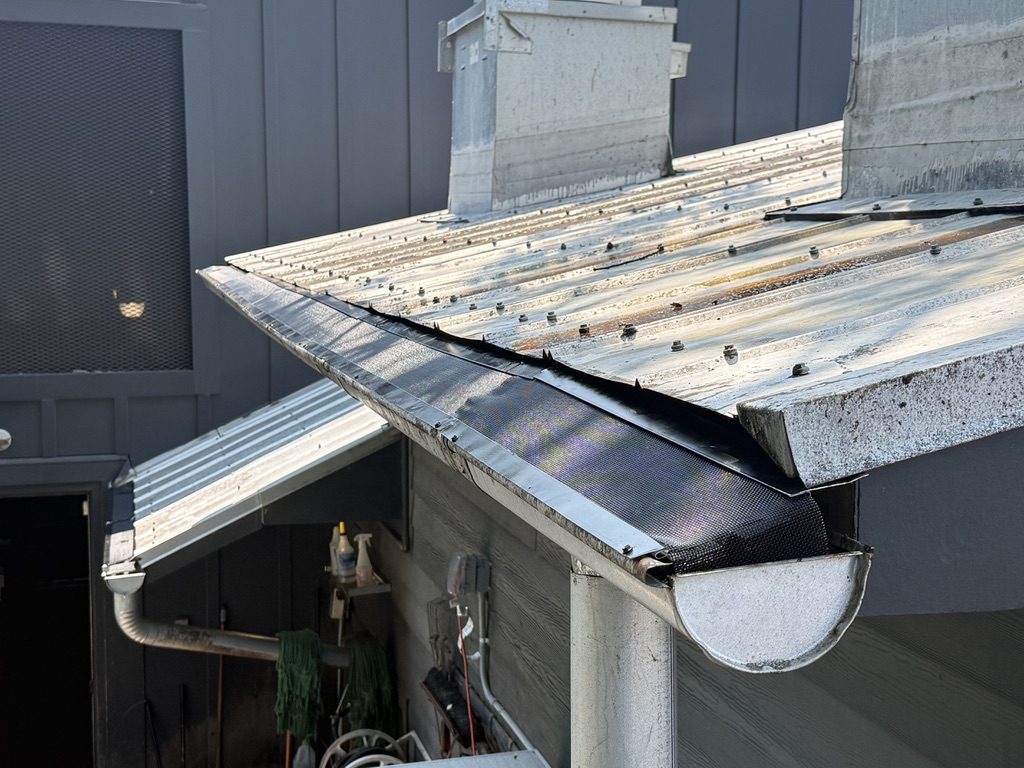
Seamless runs help here. Gutters formed on site in one piece only have seams at the corners and ends, so there are fewer joints for wind and water to work open. If your guards took a beating, our crews check BroGuard fine metal mesh and any other guard the same way, section by section.
Sources: NOAA NCEI Storm Events Database, tropical and storm surge records 2016 to 2025; NOAA 1991 to 2020 normals, Charleston Intl Airport.
Wind, trees and your roofline
In the Lowcountry, wind damage usually means a live oak limb
Read NOAA’s wind reports for Charleston, Berkeley and Dorchester and the same words keep coming up: tree down, limbs down, a tree on a home. That is what wind does to gutters here.
Thunderstorm wind is the most common report in all three counties, and most of those reports exist because someone saw trees or power lines come down and the National Weather Service estimated the gust from the damage. Under the live oaks of West Ashley, James Island and Mount Pleasant and the tall pines around Summerville and Goose Creek, a summer gust that would only rattle a window in an open field drops limbs onto rooflines.
A falling limb is the most direct threat to a gutter. It can flatten a run, rip hangers out of the fascia or bend a downspout off the wall. Smaller damage hides better. A gutter that took a glancing hit can look straight from the driveway while two hangers have pulled loose and the run has lost its pitch, so it holds water instead of draining.
Tropical storms add hours of steady wind on top of soaked ground. NOAA’s Irma record for Charleston County in September 2017 lists a large live oak down on a house and a vehicle on Gulf Drive in Mount Pleasant, with a 60 mph gust at the airport.
After a wind storm, look for these
- A run that sags between hangers or tips away from the fascia board
- Hangers backed out of the wood or rusted
- Downspouts pulled off the wall or knocked off their extensions
- Live oak twigs, Spanish moss and pine straw piled in the trough
- Water running behind the gutter instead of into it in the next rain
- Fascia that is cracked, split or soft where a limb hit
If the storm pulled the gutter away from rotten wood, we can replace the fascia board before the gutter goes back up. If it only needs to be rehung and pitched, that is a gutter repair, and you get the price in writing before any work starts.
Sources: NOAA NCEI Storm Events Database, thunderstorm wind reports 2016 to 2025 and tropical storm records for Charleston County (Irma, September 11, 2017; Dorian, September 2019); National Weather Service severe thunderstorm definition.
After the storm
A safe walk-around, then a free gutter check
You can learn a lot from the ground in ten minutes. Leave the ladder in the garage until the roof is dry, the wind has dropped and the power lines are clear.
- Stay clear of lines and limbsTreat every downed wire as live, and keep away from limbs hanging on the roof or caught in the gutters.
- Walk the house from the groundLook along each run for sags, gaps and dents, and at each downspout for kinks or pieces that came apart.
- Take dated photosPhotograph each side of the house and anything that looks off, so you have a clear record for later.
- Watch the next rainWater spilling over the front, dripping at corners or pouring behind the gutter tells you where the damage is.
- Check where the water landsMake sure every downspout still empties onto an extension or splash block, not under the house or against the foundation.
- Book the free checkA crew member walks the roofline, flushes the downspouts and gives you a written estimate only if something needs fixing.
Raised homes are part of why the last step matters. A downspout knocked loose by a storm dumps the whole roof’s water under the house, around the piers, the stairs and the ground-floor storage, and soaks the ground the house stands on. Ask us to check the downspouts and extensions too, since storm debris and sand can plug a downspout from the inside where you cannot see it.
Want your gutters ready before the next tropical system, not just checked after it? Read our Hurricane Season Gutter Prep guide for the cleaning, repairs and downspout changes to make before a storm is in the forecast.
Storm came through your neighborhood? Call (843) 867-2267
Book a Free Post-Storm CheckStorm Check Questions, Answered
Every number comes from the NOAA National Centers for Environmental Information Storm Events Database. We downloaded the detail files for 2016 through 2025 and counted the tropical, coastal flood, flood, thunderstorm wind, hail and tornado records for Charleston, Berkeley and Dorchester counties ourselves.
NOAA files tropical storm, storm surge and coastal flood records by forecast zone, not by town, and one storm can leave several records in the same county, such as one for wind and one for surge. So the 44 tropical records from 2016 to 2025 came from 16 systems on 20 days. Wind, hail, flood and tornado reports are filed by county.
Yes. Helene came ashore in Florida’s Big Bend in September 2024, yet NOAA’s records describe trees and power lines down across Charleston, Berkeley and Dorchester counties and a 63 mph gust at Charleston International Airport. Wind-driven rain, falling limbs and debris packed into the outlets can all hurt a gutter system without a direct hit.
Atlantic hurricane season runs June 1 to November 30 and peaks around September 10, according to the National Hurricane Center. Squall lines come earlier: the three busiest wind days in our NOAA data were April 19, 2019, April 13, 2020 and April 5, 2022, and summer thunderstorms follow.
It depends on the damage. A crushed downspout piece, a cracked corner seam or a few loose hangers can usually be repaired. Long runs with a bent lip, rusted hangers or low spots that hold water are often better replaced with a new seamless section. A Solutionist will tell you which, in writing, before any work starts.
A crew member walks the roofline, looks over every run, seam, hanger and guard, and flushes the downspouts to make sure water still drains away from the house. You hear what we found, and if anything needs work you get a free written estimate. If nothing does, we tell you that too.
Reviews
What Charleston Homeowners Say
“Big thanks to Justin Jenkins from Brothers Gutters for the fast repair on my hanging gutter. Great price and even better customer service. I’ll definitely be using them again and will recommend them to all of my clients and neighbors!!”
Posted on Google“The Brothers that do Gutters are amazing! It’s been an outstanding experience from the very beginning! The price is great, customer service fantastic and installation crew without peer! I will and have recommended them to friends and family!”
Posted on Google“I asked them to come to my house to quote a gutter repair. While they could not fix it that day, they came back within a couple of days and fixed my gutter free of charge. You can’t ask for better service and nicer people. There is no doubt that the next time I need new gutters, TBTJDG will be who I call.”
Posted on GoogleService area
Charleston and Lowcountry communities we serve
Every community on this list is inside our service area and gets the same local crew, seamless gutters formed on site and free written estimates. Call (843) 867-2267 or request a free quote and a Solutionist will come out.
- Mount Pleasant
- Charleston
- West Ashley
- James Island
- Daniel Island
- North Charleston
- Hanahan
- Goose Creek
- Ladson
- Summerville
- Johns Island
- Folly Beach
- Isle of Palms
- Sullivan’s Island
- Awendaw
- McClellanville
Free post-storm check
Did the last storm leave its mark on your gutters?
Book a free, no-pressure post-storm check. A local Solutionist will walk the roofline, flush every downspout and tell you plainly what the storm did and did not do.
The Brothers That Just Do Gutters · Charleston · (843) 867-2267 · Serving the Lowcountry
Local guides
More gutter guides for Charleston homes
 Hurricane Season Gutter Prep in Charleston and the Lowcountry
 Gutters on Historic Homes in Charleston: BAR and Old Village Guide
Veteran Owned & Operated in Mount Pleasant, SC · Serving Charleston, Berkeley & Dorchester Counties