

The Brothers That Just Do Gutters · Charleston
Commercial Gutters in Charleston, SC
Apartment communities and HOAs, retail centers along Rivers Avenue, Johnnie Dodds and Savannah Highway, medical and professional offices, churches, schools and warehouses from Mount Pleasant and Daniel Island through Charleston, West Ashley and North Charleston to Summerville and Goose Creek. Seamless commercial runs formed on site, sized for the summer afternoon downpours that bring close to half of the Lowcountry rain, and scheduled service your property manager can plan around.
- Veteran Owned & Operated
- Seamless Runs Formed On Site
- Serving the Lowcountry
- Locally owned in Mount Pleasant
- Gutters are all we do
- Free written scope
Quick answer
Commercial gutters in Charleston, SC:The Brothers That Just Do Gutters Charleston installs, repairs, cleans and maintains commercial gutter systems on apartment communities, condos and HOAs, retail centers, medical and professional offices, churches, schools and warehouses across Charleston, Berkeley and Dorchester counties, from Mount Pleasant and Daniel Island to West Ashley, North Charleston, Summerville and Goose Creek. Seamless aluminum, steel and copper runs are formed on site in 6 inch and 7 inch profiles, with BroGuard fine metal mesh for the buildings that keep filling with pine straw. Estimates are free. Call (843) 867-2267 or book a walkthrough online.
Built for buildings, not houses
Commercial rooflines fail differently
A house sends a few hundred square feet of roof through a 5 inch trough. An apartment building or a retail strip can send ten times that through a run nobody looks at until it is pouring over a doorway. Here close to half of the year’s 52 and a half inches lands between June and September, much of it in short afternoon thunderstorms, and by then the trough is often holding pine straw, live oak leaves, sweetgum balls and spring pollen. We size the system for the roof that is actually there and for the way the rain actually arrives.
- Sized from real roof area and Lowcountry storm intensity, not a default profile
- 6 inch and 7 inch seamless runs formed on site, so long walls get fewer seams
- Added and oversized downspouts where the math calls for them
- Heavier hangers and tighter spacing on long runs that carry a full storm
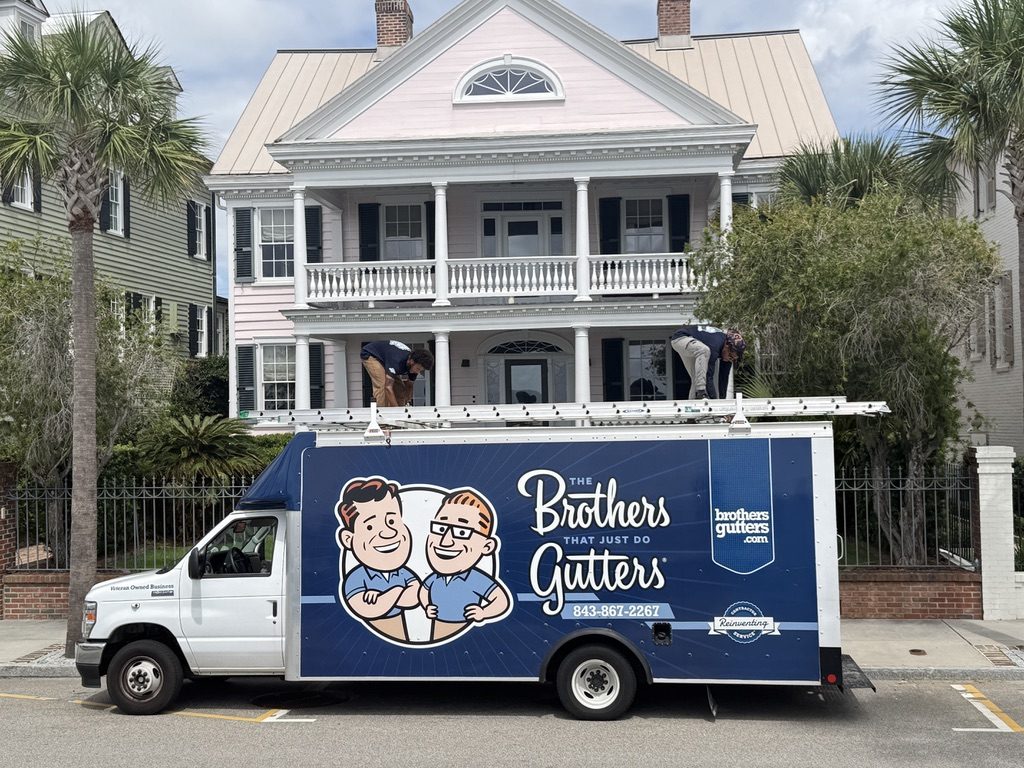
Sizing and capacity
Your gutters are too small for the building
Most of the overflow we get called out for is not a one-off clog. It is a system that was never big enough for the roof above it. A builder puts a residential 5 inch profile and a couple of outlets on a long, shallow roof plane, and it holds up fine until the first big summer thunderstorm lands on it.
The fix is arithmetic before it is labor. We measure the contributing roof area, work out what it has to carry when an August afternoon storm comes through hard and fast, and then size the trough and the number of outlets to match. Sometimes that means a 7 inch run. Often it just means three more downspouts in the right places.
We form the runs on site, so a hundred foot wall gets one continuous piece instead of sections joined every twenty feet. Fewer seams is fewer future leaks, and on a commercial elevation it also simply looks better.
Specification
Residential vs commercial
This is the difference between a gutter that survives a Lowcountry thunderstorm season and one that gets replaced in three years.
| What we look at | Typical residential | What a commercial building needs |
|---|---|---|
| Trough profile | 5 inch K-style on most homes | 6 inch standard, 7 inch on long or low-slope roof planes and anywhere the contributing area is large |
| Downspout size | 2 by 3 inch | 3 by 4 inch or larger, sized to the outlets rather than to what was on the truck |
| Outlet count | One per 30 to 40 feet is common | Calculated from roof area and peak storm intensity, which usually means more outlets than the original build had |
| Hanger spacing | 24 to 36 inches | Tightened, because a full commercial run carries serious weight and the fascia behind it has to take it |
| Material | .027 aluminum is typical | Heavier gauge aluminum, steel or copper, chosen for the length of the run and the roof above it |
| Seams | Sections joined as needed | Formed on site in one continuous run wherever the wall allows, because every seam is a future leak |
| Maintenance | Once or twice a year | Scheduled, documented visits tied to the tenant calendar and to storm season, with photos after each one |
| Paperwork | A receipt | Written scope, photo record and damage documentation you can hand to an owner, a board or an insurer |
Commercial services
What we handle on commercial rooflines
One local crew for the whole system, from the trough to where the water leaves the property.
Seamless 6 inch and 7 inch runs formed on site and sized to the roof area above them.
Learn more Commercial RepairLeaking seams, sagging runs, pulled hangers and storm damage, documented as we go.
Learn more Cleaning & Maintenance PlansScheduled visits with photos and notes, built around spring pollen, the summer storm window and the fall pine drop.
Learn more Downspouts & DrainageMore outlets, larger downspouts and underground routing that moves water off the property instead of into the foundation.
Learn more BroGuard Gutter GuardsBroGuard fine metal mesh that keeps pine straw, live oak leaves and sweetgum balls out of the trough on long commercial runs.
Learn more Fascia & Roof EdgeIf the board behind the gutter has gone soft, hangers will not hold. We fix the edge too.
Learn more 7 Inch Commercial ProfilesWhen a 6 inch trough cannot carry what the roof above it produces, we step up to 7 inch with oversized outlets.
Learn more Seamless Commercial RunsFormed from coil on our truck to the exact length of each wall, in aluminum, steel or copper.
Learn more Free estimateRequest a Commercial QuoteSend us the building and what is going on with it. A local Solutionist walks the roofline, measures the runs and leaves a written scope and price you can take to an owner or a board. No pressure, no obligation.
Book a site walkthrough or call (843) 867-2267Diagnostics
Six signs your system is undersized, not just dirty
Cleaning fixes a clog. None of these are clogs, and cleaning will only buy you a season.
- 1It sheets over the front edge in a hard rain
A clogged gutter overflows at the clog. An undersized one overflows evenly along the whole run, usually right over an entrance or a walkway. That is a capacity problem, and no amount of cleaning changes it.
- 2Staining or streaking down the wall below the trough
Vertical marks under the gutter line mean water has been going over the edge regularly, not once. On brick, stucco or painted siding that staining is the early warning before you get real damage.
- 3Hangers pulling loose or spacing that has opened up
Commercial runs are heavy when full. If the hangers are spaced like a house or the fascia behind them has softened, the run starts to sag and the slope stops working.
- 4Water pooling at the base of the building
Standing water near the foundation, or a downspout that just dumps at the base of the wall, means the system is moving water out of the gutter but not away from the property. That is a drainage fix, not a gutter fix.
- 5A season of debris sitting in the trough
By November a neglected commercial gutter is a long tray of pine straw, oak leaves and sweetgum balls running the whole length of the building, and the next hard rain turns it into a dam. Boards and property managers ask about it, and they are right to.
- 6Water dumping onto walkways, docks and parking
A downspout that empties where people walk or park is not just a puddle. It is a slip claim after an August storm, a stain on the concrete by fall and asphalt that fails years early. Commercial water has to be carried away from the building, not just off the roof.
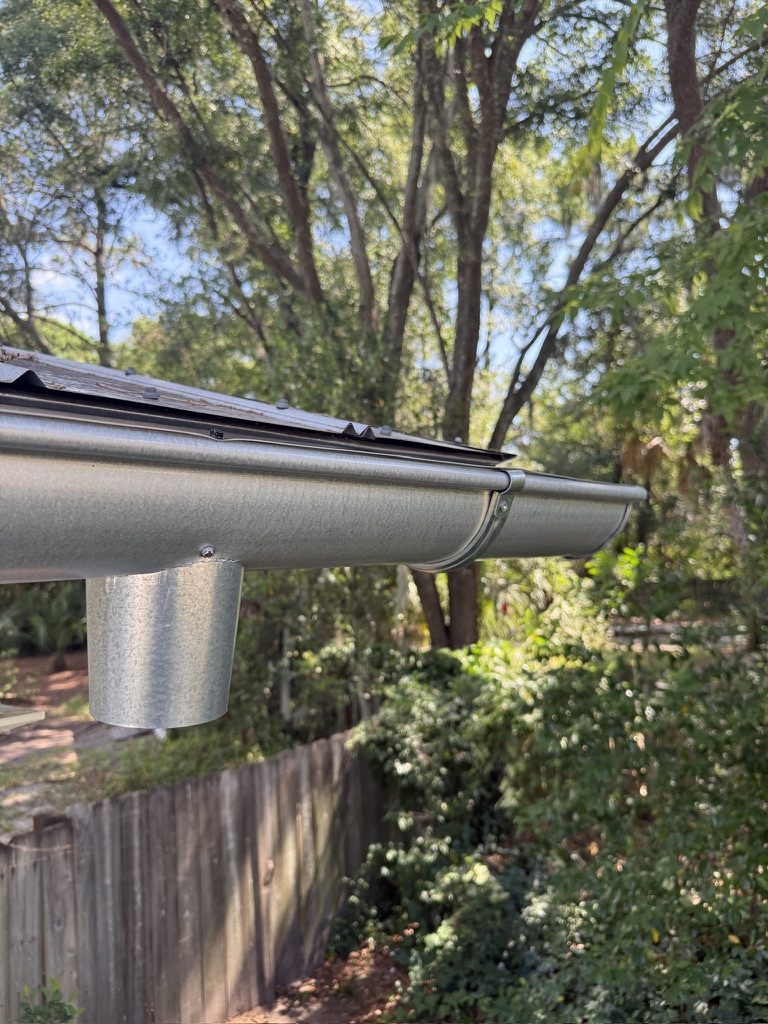
Maintenance plans
Maintenance your property manager can plan around
Commercial gutters rarely get attention until something goes wrong, and by then the damage is usually fascia, soffit or an interior ceiling tile rather than the gutter itself. A plan turns that into a line item you can budget instead of an emergency you cannot.
Ours runs on the Lowcountry calendar. Pollen and oak catkins seal outlets in the spring, so we clear them before the summer storms. The heavy clean lands after the fall pine drop, and we check hangers, seams and slope in the calmer winter months. Every visit comes with photos and notes on what we found.
If you manage several buildings, you get one point of contact and one set of records across all of them. No chasing three different crews for three different properties.
Property types
Commercial properties we work on
From Mount Pleasant and Daniel Island to West Ashley, Summerville and the condo buildings on the islands, multifamily keeps growing here, and one failing run turns into a stack of maintenance tickets.
Brick and stucco along Rivers Avenue, Savannah Highway and Coleman Boulevard, much of it on gutters from decades ago.
Shared rooflines, tenant turnover and walkways underneath. Overflow here is a liability question as much as a building one.
Warehouse and flex buildings around North Charleston, Ladson, Hanahan and Goose Creek, with very long runs, parapets and very few outlets.
Steep roofs, tall elevations and volunteer upkeep, from historic downtown churches to school campuses. Often still on original gutters.
Patient entrances, covered walkways and parking that has to stay dry and safe in a hard rain.
Year-round
Your Charleston gutter calendar
How the year plays out on Lowcountry rooflines, and what our crews are doing in each stretch.
- Fall · Sep to NovPine drop clean-outs
Pine straw, oak leaves and sweetgum balls cleared from troughs and outlets while late-season storms are still rolling through.
- Winter · Dec to FebRepair and replacement
The calmer months for rehanging sagging runs, swapping out leaky sectional gutters and fixing fascia before spring.
- Spring · Mar to MayPollen and catkin season
Pine pollen and oak catkins flushed out of the outlets, and BroGuard installed before the summer storms arrive.
- Summer · Jun to AugThunderstorm season
The wettest stretch of the year. Overflow calls, downspout upgrades and new seamless gutters sized for the downpour.
How commercial work runs
How a commercial job runs
- 1Call or send the address
Tell us the building and what is happening. A local Solutionist answers, not a call center in another state.
- 2On-site walkthrough
We measure the runs, check the roof area feeding them, look at the fascia and see where the water is actually going.
- 3Written scope and number
You get the recommendation in writing with the reasoning behind it, so you can take it to an owner or a board without translating it.
- 4Work scheduled around you
Early mornings, weekends or between shifts. We keep entrances and docks clear and leave the property clean.
Straight answer on pricing
What drives the number
We are not going to put a price per foot on a web page, because the honest answer is that two buildings the same size can be very different jobs. Here is what moves it, so you can walk into the walkthrough already knowing what we will be looking at.
- Total linear feet and how the walls break up. One long uninterrupted elevation is faster and cleaner than the same footage broken into eight short returns.
- Profile and material. 6 inch aluminum sits at one end. 7 inch, heavier gauge or steel sits at the other. The roof above decides which one is right, not the budget.
- Height and access. Single story with clear parking is straightforward. Three stories over a landscaped bed or an active loading dock is a different day of work.
- How many outlets and where they can go. Adding downspouts is usually the most affordable real fix on an undersized system, but where they can land depends on doors, drives and grade.
- Whether the fascia is sound. If the board behind the gutter has gone soft, new hangers have nothing to hold. We will tell you at the walkthrough rather than after we have started.
- Drainage at the bottom.Dumping water at the foundation is the cheap option and creates a bigger problem. Routing it underground and away costs more and ends the issue.
Estimates are free, written and carry no pressure attached to them. If a larger scope needs to be phased across a budget year, say so at the walkthrough and we will scope it that way.
Why the Brothers
Why property managers and building owners call us
Not roofing with a gutter crew attached. The whole company is built around the roofline, which is why we catch sizing problems a general contractor walks past.
The people who walk your property are our own local crew out of Mount Pleasant, and they are the same people who will be back next season.
The truck makes the gutter in your parking lot to the exact length of your wall. That is how a hundred foot elevation ends up with no seams in it.
Measured scope, clear reasoning and photo documentation. Enough detail that you can forward it to an owner or a board without having to explain it.
Commercial gutter questions we get
We install, repair, clean and maintain gutters on apartment buildings, condos and HOAs, retail centers and strip retail, medical and professional offices, churches, schools, older commercial buildings along the main corridors and light industrial space. We cover Charleston, Berkeley and Dorchester counties, from Mount Pleasant and the islands to Summerville and Goose Creek, with seamless runs formed on site.
Most commercial buildings need 6 inch gutters as a standard, and long or low-slope roof planes often need 7 inch. We measure the roof area feeding each run and size it for how rain actually arrives in Charleston, where close to half of the roughly 52 inches a year falls June through September in hard afternoon thunderstorms, not for a default residential profile.
On commercial buildings it is usually capacity, not a clog. A clogged gutter overflows at the clog, while an undersized one sheets evenly over the front along the whole run, often right above an entrance. Cleaning buys a season. Resizing the trough or adding downspouts fixes it.
Because a large commercial roof sends far more water to each outlet than a house does. We calculate the number from the roof area and peak storm intensity, which usually means more outlets than the original build had. Commercial downspouts are 3×4 inches or larger, sized to the outlets. Often the fix for chronic overflow is simply adding downspouts in the right places.
Yes. Scheduled maintenance plans come with documented visits, photo records and one point of contact across every building you manage. Visits are built around spring pollen, the summer thunderstorm season and the fall pine drop, and you get a written record you can hand to an owner, a board or an insurer.
Yes. BroGuard fine metal mesh keeps pine straw, oak leaves and sweetgum balls out of long commercial runs, so the system drains between visits instead of overflowing over an entrance. It carries a limited lifetime warranty, and you get a written scope and photo record of the work. Call (843) 867-2267 to book a site walkthrough.
Service area
Charleston and Lowcountry communities we serve
Every community on this list is inside our service area and gets the same local crew, seamless gutters formed on site and free written estimates. Call (843) 867-2267 or request a free quote and a Solutionist will come out.
- Mount Pleasant
- Charleston
- West Ashley
- James Island
- Daniel Island
- North Charleston
- Hanahan
- Goose Creek
- Ladson
- Summerville
- Johns Island
- Folly Beach
- Isle of Palms
- Sullivan’s Island
- Awendaw
- McClellanville
Free commercial estimates
Get a real number on your building
Free walkthrough, measured runs and a written scope you can hand to an owner or a board. Veteran owned, run out of Mount Pleasant, and worked by our own local crew, who will be back next season too.
The Brothers That Just Do Gutters · Charleston · (843) 867-2267 · Serving the Lowcountry
Veteran Owned & Operated in Mount Pleasant, SC · Serving Charleston, Berkeley & Dorchester Counties